Begin with the unit of the claim
Finding a paper beneath a claim is only the beginning. The next task is to decide whether the paper’s question matches the claim’s question. For a duration claim, the crucial distinction is between how long an event lasts and how likely someone is to experience an event at all.
The first question starts after an event has been identified. It needs a starting point, a definition of resolution, and observation long enough to distinguish resolution from information ending. The second needs a defined population that includes people without the event, a common observation period, and a rule for deciding whether each person experienced it.
These questions cannot exchange denominators. A collection of recorded events does not supply the people who remained outside that collection. Equally, knowing whether someone ever reported an event does not reveal its duration. Before interpreting a comparison, complete this sentence: the proposed statement concerns a particular outcome, among a particular set of observations, during a particular interval. If filling those spaces changes the claim, the original claim needed clarification before any numerical comparison could answer it.
Keep trial design attached to the question
STEP-1–3 studied adults with overweight or obesity for 68 weeks; STEP-2 included type 2 diabetes, and STEP-3 used intensive behavioral therapy.[2]
A common observation horizon can make two study questions easier to align without making their participants interchangeable. Imagine comparing studies that end at the same scheduled point but use different rules for entry. Their calendars could agree while the groups eligible to contribute information differ. Matching the calendar would resolve one comparison problem and leave another intact.
For a proposed extension to a new population, identify the selection rule that matters to the argument. Would the new group have qualified under that rule? If not, what additional information would justify expecting the same relationship between the measured outcome and the conditions under study? This is a question about the proposed extension, not evidence that a particular subgroup must respond differently.
Background care also belongs in the question. If an estimate is to support a claim in another setting, specify what care would accompany the intervention there. A comparison that changes both the intervention and its surrounding care would require a justification for attributing any difference to one component. Merely giving the intervention the same name would not provide that justification.
A useful transport check would therefore compare eligibility, accompanying care, outcome definitions, and the opportunity to observe resolution before combining conclusions. If you read the companion study analysis, bring those questions to its comparison too. This is a way to assess whether two arguments address comparable targets, rather than treating their shared subject as permission to combine their answers.
Read the duration figure
Post hoc durations used Kaplan–Meier estimation; on-treatment events required a dose within the previous 49 days.[1]
Read the figure by separating its measurement scale, its category labels, and the statistic named in its caption. The scale tells you how a position is expressed; the categories tell you which observations are being summarized. The summary statistic determines what feature of those observations a position can represent. Visual distance alone does not specify a causal question.
For a central duration estimate, ask what starts and stops the clock. A defensible event record would need an event identifier, a participant identifier, an onset record, and either a documented resolution or a last observation with its status. The distinction between those last possibilities matters: a record ending is not necessarily an event ending. Group labels must also connect each record to the comparison being proposed.
An event summary should not silently become an average burden across everybody assigned treatment. To construct that different outcome, an analyst would need information about people without recorded events and a defined way of combining multiple periods within a person. It would also require choosing whether the target is calendar time affected, an event count, or another explicitly defined measure.
Keep the graphical comparison at the level its stated statistic permits. Do not treat the whole enrolled population as the denominator of every number drawn on an axis. Instead, request the record selection rule and the calculation that takes those selected records to the plotted position. That would let a reader connect the picture to an auditable calculation without guessing what an unlabeled denominator represents.
Reading the duration
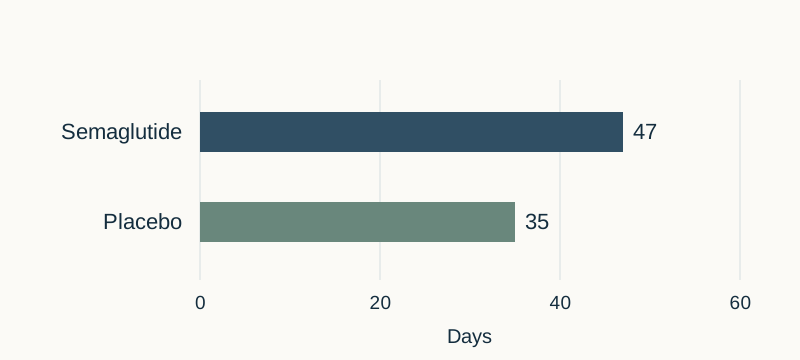
| Arm | Days |
|---|---|
| Semaglutide | 47 |
| Placebo | 35 |
Ask what a median leaves undecided
Consider two hypothetical collections of completed event durations with the same middle value. In one collection, durations above the middle stay relatively close together. In the other, some extend much farther beyond it. Those longer observations could change substantially while the middle stays in the same place. This example describes a mathematical possibility, not reconstructed trial observations.
The distinction matters because a midpoint and an upper limit answer different questions. A midpoint locates a central part of a distribution. A maximum concerns the farthest observed value, while an upper percentile concerns a specified position toward the tail. Neither can be recovered by treating the middle as a boundary beyond which events cannot continue.
Total time also asks for information the midpoint discards. If the longer durations in the hypothetical collection increase without crossing back through its middle, the sum can increase even though the median remains unchanged. Consequently, a median alone cannot identify an average duration or the amount of time accumulated across records. The missing information is the distribution away from its center, not a different way of reading the same central number.
Nor would adding a range automatically make a personal waiting rule valid. A range would describe observed extremes under an observation process; a decision about an individual would require a different justification. To characterize the tail scientifically, ask which later portions of the distribution are estimable, how much observation supports them, and how uncertain they are. Those questions seek additional information rather than stretching the meaning of a median.
Follow the observation clock
Imagine an abstract record whose event has begun but is still unresolved at its last observation. That record establishes something about duration: resolution had not been documented by that point. It does not establish the eventual endpoint. Treating the last contact as a resolution would turn the end of information into an outcome, even though the record distinguishes them.
A time analysis must decide how such an incomplete record contributes while it remains informative. It must also justify what can be inferred from records still observed after other records stop contributing. If losing observation were related to an unrecorded feature that also predicts resolution, the remaining observations might not represent the missing ones. An analysis would need assumptions or additional evidence to address that possibility.
This is separate from deciding which events qualify for inclusion. An eligibility clock might determine whether a record belongs in an analysis; a duration clock measures the interval whose endpoint is of interest. Changing the inclusion rule does not, by itself, establish that the event resolved when eligibility ended. The two rules need separate definitions even if they use some of the same dates.
A useful audit would reconstruct who could contribute at each stage of the clock, why contributions ended, and whether resolution status agreed with the underlying record. It could then compare conclusions under alternative defensible ways of handling uncertain endpoints. Such a sensitivity exercise would expose dependence on an assumption. It would not prove that one unobserved resolution date was the true date, and no particular handling rule should be attributed to a paper without checking its documentation.
Keep events and people separate
A hypothetical dataset might contain several event rows linked to the same participant. If every row contributes equally to an event summary, a participant with several records contributes more observations than a participant with one. That is a property of the chosen unit of analysis. It need not be an error, but it must match the question the summary is intended to answer.
To ask about time affected per person, the records would have to be assembled differently. An analyst would need a rule for separate episodes, a rule for apparent continuation of the same episode, and a way to handle overlapping intervals. Simply adding all row durations could count the same calendar time more than once if intervals overlap. The intended measure should determine whether that duplication is appropriate.
The chance of recurrence requires another starting point. One possible question would begin after a documented resolution and follow people for a specified opportunity to experience another event. That population and clock differ from a collection of event lengths. Without defining the opportunity to observe a recurrence, its absence in a record could mean either that none was observed or that observation was insufficient.
Participant identifiers also allow an uncertainty calculation to respect the grouping of records. A proposed analysis could resample whole participants rather than treating every event row as independent, then examine how uncertainty changes. This would test the consequences of repeated contributions without presuming any particular recurrence pattern. Duration, recurrence, and cumulative burden can therefore be related scientifically while remaining distinct outcomes that need distinct records and calculations.
Compare distributions before making promises
Suppose a treatment is assigned randomly and an analyst later compares durations only among people who experience an event. Random assignment addresses comparability at the moment of assignment. It does not automatically establish comparability after selecting participants according to something that happens afterward. The second comparison has introduced a new entry condition.
To see the issue, consider a hypothetical characteristic that affects both whether an event occurs and how long it lasts. If assignment also affects whether an event enters the record, the selected groups could contain different mixtures of that characteristic. A duration contrast could then reflect the selection process as well as anything affecting duration. This argument identifies a possible route to distortion; it does not establish that distortion occurred or predict its direction.
One causal question would concern people who would experience the event under either assignment. Yet observing an individual under one assignment does not reveal whether that same individual would have experienced it under the other. Naming this target group does not make its membership observable. Additional assumptions would be needed to connect a comparison among recorded events to that counterfactual question.
A proposed sensitivity analysis could vary assumptions about selection and examine whether the interpretation survives. Where relevant characteristics are recorded, analysts could check overlap between the selected groups before attempting adjustment. They could also ask an assignment-based question defined for everybody, such as time affected over a specified period, provided the necessary records exist. That alternative changes the scientific target rather than repairing a conditional comparison by relabeling it.
Specify the new intervention
A claim that a new strategy shortens an event needs a design that varies that strategy. Define what would be offered, who would be eligible when it is offered, and which concurrent alternative would provide the comparison. The proposal should identify the effect of that choice, rather than borrowing an earlier duration as though it were a matched control.
One possible design would randomize an appropriately supervised symptom-management strategy among eligible participants with a defined ongoing event. The resulting question would concern those eligible symptomatic participants at that stage. It would not automatically answer whether the strategy prevents an event, nor would it describe people who could never meet the eligibility rule. The timing of randomization therefore belongs in the target population’s definition.
Specify a common assessment schedule and a resolution rule before collecting the comparison. If assessments occur at different intervals, a recorded difference could reflect when information was sought. Decide how recurrence, additional interventions, withdrawal, and incomplete observation would be represented. The outcome might be time to a defined resolution or time affected within a fixed period; choosing between them changes what a successful result would mean.
The design would also need to distinguish the assigned strategy from what participants actually received, with both recorded rather than silently substituted. An analysis of assignment and an analysis of receipt ask different questions. For the language surrounding a proposed claim, use how to read online medication reviews to keep the statement tied to the comparison that could test it. A persuasive explanation for trying a strategy is still different from a comparison capable of evaluating its effect.
Make the evidence traceable
Novo Nordisk funded trials and writing; three authors disclosed employment and shareholding.[1]
Disclosure helps identify relationships a reader should know about. It cannot, on its own, determine whether a calculation is reproducible or whether a conclusion follows from it. Those questions require examination of the records, definitions, and analytic decisions. Neither suspicion nor reassurance supplies a missing method.
A concrete request would ask for the event dictionary, the planned contrast, the rules for incomplete records, and the sensitivity analyses used to test important assumptions. The dictionary should connect a coded event to its onset and resolution criteria. The analysis record should distinguish a question specified beforehand from one proposed after inspecting results, so that readers can evaluate how the question was chosen.
Then inspect the bridge from the estimate to the claim: has the outcome, intervention, or target population changed? Each change needs justification. For a separate reading task about dated provider documentation, open the CoreAge Rx review. Keep that task separate from evaluating a scientific comparison; a link between the pages cannot supply evidence for a claim about a service.
Keep clinical care outside the statistic
Wegovy delays gastric emptying and is not recommended with severe gastroparesis. Contraindications include personal or family medullary thyroid carcinoma history, multiple endocrine neoplasia type 2, and prior serious semaglutide or ingredient hypersensitivity. Persistent or severe abdominal pain needs prompt assessment; gastrointestinal dehydration can damage kidneys.[3]
Compounded products lack FDA approval.[4]
Do not use a statistical midpoint as a rule for deciding whether an individual should wait, continue, or alter treatment. The relevant decision requires a clinical assessment, not an inference from a distribution’s center. A duration argument can clarify what a result means without deciding what someone should do next.
Use the semaglutide profile to locate its scope and references, and consult the complete prescribing information among the cited sources for clinical detail. This analysis offers no dietary, dosing, or symptom-treatment protocol.
Reader questions
Can a median tell me the longest an event might last?
No. A longest observed duration would require information about the extreme observations, and a possible future maximum would require an additional basis for extrapolation. Even identifying the largest completed record would leave a different question if unresolved records remain under observation. The useful follow-up is therefore not just “what was the biggest value?” but whether the observation process could have captured the portion of the tail relevant to the proposed claim.
Would a shorter duration establish that a proposed intervention helped?
Only a comparison capable of separating the intervention from other explanations could support that attribution. Specify a concurrent control, a shared starting point, and eligibility that defines whom the answer concerns. If the intervention is introduced after symptoms begin, the target should reflect that timing. A shorter recorded interval is an outcome description; attributing it to the intervention requires a defensible account of what would have happened under the alternative.
What information would make this result easier to audit?
Start with the event dictionary and a record showing how onset, last observation, and resolution are distinguished. That would clarify whether the clock ends because an event resolves or because information stops. Next, request the rule connecting those records to the analysis. A summary can be arithmetically reproducible yet answer the wrong question if the event definition or endpoint differs from the claim, so the coding rule comes before recalculating a number.
Editorial assessment
The strongest use of a duration contrast is to sharpen a question whose observation unit and endpoint are explicit. Its usefulness should be judged by whether the records support that question, not by how readily the plotted difference can be turned into a promise. A claim about shortening symptoms introduces a new intervention and therefore a new comparison to identify. The decisive next evidence would connect a defined strategy to an appropriate concurrent alternative, begin observation at a common decision point, and retain a clear account of unresolved and recurrent events. It would also state which population the resulting answer concerns. If those conditions cannot be specified, the difficulty is more basic than the precision of an estimate: the claim has not yet been translated into a testable target. If they can, the earlier description can help formulate the question while the new comparison carries the burden of evaluating the intervention.
Limits of this analysis
This argument examines the logic of duration claims; it does not reconstruct individual records or independently validate event coding. The hypothetical examples are demonstrations, not trial observations. No individual outcome is predicted, and this article has not undergone an independent clinical review.
References
- Wharton (2022) · Diabetes Obes MetabSource checked 2026-10-28
- Kushner (2020) · ObesitySource checked 2026-10-28
- WEGOVY · NLMSource checked 2026-10-28
- FDA GLP-1 · FDASource checked 2026-10-28
Our methodology · Advertising disclosure · Request a correction